Wednesday, 27 February 2019

Top Benefits Of Lean Six Sigma Black Belt Certification

Lean Six Sigma Black Belt Program is one of the top 10 most sought after certification program in the world today. The reason being, over the last few decades Lean and Six Sigma methodologies, are being increasingly used across industries to improve the business profitability.

As the number of companies who look for ways to cut costs, improve efficiency and reduce waste increases, the adoption of Lean and Six Sigma will continue to increase.

Until today most of the large-scale Lean and Six Sigma deployments are done by the Consultants. But as the methodologies of Lean and Six Sigma are becoming the mainstream, companies are expecting their employees to become skillful in these.

The increased demand has led many professionals to opt for Lean Six Sigma Black Belt training program. These training programs not only enhance your career prospects but also augurs fully in business intelligence and problem-solving expertise.


As we can see from the list, Lean and Six Sigma methodology has a direct impact on 3 of the top 6 skills. They are,
  1. Analytical Thinking
  2. Strategic Thinking
  3. Creative Problem-Solving
By doing the Lean Six Sigma Black Belt Program, you will have addressed the gaps in above skills and gained significant expertise.

Moreover, with rapid automation happening across industries, Problem Solving is one of the core skill, every professional should possess to survive and grow in the industry and Lean Six Sigma addresses this very core skill.

Producing Results: The overall purpose of becoming the champion in Lean Six Sigma Black Belt is to start producing results, right away at your Organization. Lean helps you to eliminate waste, improve the timeliness and productivity and Six Sigma reduces the variability, thus improving the overall quality. Hence, as a Black Belt you will be directly responsible for improving business profitability, customer satisfaction, customer loyalty and employee satisfaction.

Team Management & Leadership Skills: As we saw from Bloomberg Report, the Ability to collaborate & Leadership skills are most sought after skills. By understanding the fundamentals of the problem-solving concepts, a Lean Six Sigma Black Belt champion can start looking at things in a more structured way than others. Team development, Change Management, Getting stakeholder approval, working collaboratively across teams are something Lean Six Sigma Black Belt Program addresses and help the participant to get exposed and become proficient. These soft skills take more time to master, but Lean Six Sigma provides a fundamental framework to begin.

Get Recognized: Who doesn’t wish to get recognized in the team or across the organization? But, have you asked what it takes to get recognized? It is by producing breakthrough improvements in existing work areas. As a Black Belt Champion, you will be at the forefront to make improvements in the day to day operations as well as long-term projects.  By consistently improving deliverables, you are bound to get recognized by the top management.

Exceed Expectations: In today’s world, no organization succeeds, if their employees just meet expectations. Organizations cherish people who handsomely beat expectations and in the Lean Six Sigma Black Belt Program, you are taught on how to consistently  exceed expectations or KPI’s goal set for you by your organization.

Increased Confidence: Management looks for professionals who initiate and do things pro-actively and not the ones who always look for directions. So, ask yourself, how many times you felt you were not confident and up to the mark when you were asked to take up a most important and challenging project?  How many times have you gone ahead to your manager and said, I would like to take up the riskiest project, which others found difficult or said it cannot be done?

The reality is, not many do this because due to lack of confidence. By doing Lean Six Sigma Black Belt Program and getting certified helps you develop confidence so that you are ready to volunteer for challenging assignments.

Better Career Prospects: As per many recent Surveys, Lean Six Sigma Black Belt can command a minimum of 15% ~ 25% higher salaries. Not only salary hike, there will be an increased job opportunities as Lean and Six Sigma is being deployed across Product and Service oriented businesses. A word of caution, though, a mere certification will not help. It is the certificate backed by real results which help you to command salaries. For professionals who have enough success stories, the salary levels can be 200% higher than average salaries.

So, overall we discussed key benefits of doing Lean Six Sigma Black Belt Program. At SKIL Global, our Lean Six Sigma Black Belt Program  is structured in such a way we ensure you realize these benefits and develop skills to produce results right from the go.

If you are convinced, Lean Six Sigma Black Belt is the right program for you, do write to us or call us. We will be happy to partner in your career growth.

Visit SKIL to know more about Six Sigma Certification, Lean Certification, Lean Six Sigma Green Belt, Project Management, Lean Six Sigma Black Belt etc.

Tuesday, 26 February 2019

Applying Basic Statistics To Analyze Attrition Data

"we dont know what we dont measure, what we dont measure, we dont control, what we dont control, we cannot sustain or improve"

Practical scenario

About 400 people have left the company during last six months! How many days did they stay, after being hired? How many people left early enough? How many people stayed at least three months with us? We should try to retain them for at least 180 days, worst case 90 days! Says, the senior management.

Statistical question

What is the mean tenure? What are 25th, 50th and 75th percentile values of the tenure? How is the tenure of 'people left' distributed?

Statistical analysis

Use Histogram to study the distribution of tenure, find the figure below.


Histogram - Distribution is skewed (most departures are around 8 to 38 days). Between 18 to 28 days 70 people left, 20 of them left between 8 to 18 days.

Basic statistics - Calculate the basic statistics and tabulate them a table as shown below. Average number of days people stayed before they left is 63 days. 25% (25th percentile) of them left within 32 days, 50% (50th percentile or median) left within 55 days, 75% (third quartile) of them left within 86 days. The worst case was someone leaving in 8 days while the best case was 209 days! One can say with 95% confidence, average tenure will lie between 60 to 67 days.


Practical inference

Situation is alarming! We hire new people and train them for a period of one month! If average tenure is 63 days, it means they are leaving just a month after their training! We need to know why are they leaving so early. We need to move the distribution to far right. Let Production and HR department meet to draw a plan - How to ensure new hires stay for a minimum 180 days?

Tuesday, 29 January 2019

What Positive Changes Six Sigma Certification Could Bring?

Thinking about whether to pursue Six Sigma certification or not? You should if you really want to bring a positive change in your organization. This certification not just empowers you with the knowledge to bring the positive change but also prepares you to handle the future challenges. If implemented successfully, it could improve your business process for better. In fact, several companies have felt its positive impact so you aren’t alone who is going to experience the winds of change!

Let’s find out what positive change the Six Sigma could bring to you if you earn the certification:
  1. Empowers Your Employees With Knowledge
Imagine having a skilled workforce with Six Sigma certification that's ready to bring a positive change in your business process. The certification teaches them to be a catalyst for change. It helps them understand the bottlenecks in the processes and address them one by one. The Six Sigma degree holders are in a better position to read and understand data diagrams and flow charts. They work to make your system smoother, improve your relations with customers and find out the unique ways to eliminate waste in the business process.
  1. Helps Your Employees Act As Mentors
Learning and mastering Six Sigma turns your employees into future leaders who are always ready to mentor their subordinates. That means you don’t have to hire any visiting faculty to mentor your employees. Instead, the certified employees with advanced belts could do that stuff for you. It’s a milestone that you should be proud of. It sets another good example in the industry that let others know how to collaborate together to bring the winds of change and positive contribution to an organization.
  1. Sets the Tone for Success
The Six Sigma sets the tone to experience the quantum of success. As soon as your employees get certified for Six Sigma, everything starts falling at the right place! Be it about the smooth communications with your clients or managing the resources to their best. This leaves the positive impact and helps prepare your business to experience the success.
  1. Makes Your Employee Learn the Teamwork
Most employers struggle to bring their employees under one hood and do the teamwork. But after learning Six Sigma, you could see the winds of change in their behavior. Those solo workers will start working in teams. They would clearly understand that teamwork excels where the solo work fails to perform.

Conclusion

By now, you might have understood how Six Sigma certification could bring a positive change in your organization. It helps you achieve the best out of every resource that you have! Whether it is a man, material or machine. Above all, you get an active contribution from your employees. They take your organization to the next levels as they earn higher levels of Six Sigma.

Want to bring a positive change to your organization? Get your employees Six Sigma certification from SKIL and be ahead of your competitors. Six Sigma certified workforce could drive you to experience the quantum of success. Call us how to make it happen with the Six Sigma training, Lean Six Sigma Black Belt, Six Sigma Certification, Lean Six Sigma Green Belt, Project Management, Lean Certification etc.

Monday, 28 January 2019

Which Skills Do You Acquire With Project Management Training?

Playing a manager’s role accounts to many responsibilities that could only be accomplished if you are skilled enough to handle the challenges. With the right project management training, you could acquire those much-needed skills that are the building blocks of successful leadership. Being a project manager isn’t enough! You need to acquire skills that companies are willing to pay for. This is where project management course training comes to play.

Discover below to get to know which skills you are going to get equipped with if you consider project management course training.
  1. Accountability
The right project management training turns you into an accountable person who really cares for the stakeholders. It infuses project managers with a sense of accountability that takes them a long way of in the career. You will be nurtured into a successful leader with this certification. It teaches you to be accountable to a projects' growth and eventually make an active contribution to the company’s growth story.
  1. People Management Skills
While working together with a team on a project, you need to be really good at managing people. You should ward off any rifts that might distract team members to lose their focus on the project. The project management course training helps you acquire people management skills to help you execute the project delivery. With the insight gained from the training, you will be able to build better and qualified teams that could go extra miles to exceed clients’ expectations out of the projects.
  1. Better Communication
A project management certification and training make you a better communicator than the non-certified ones. It teaches you how to use the right tools and technology to facilitate the ease of communication while working on multiple projects at the same time.
  1. Resource Management
Managing the resources is a crucial aspect to which you can't put a deaf ear. Project managers are expected to utilize the man, management and machines to their optimal extent while giving the maximum output. This could be challenging for a project manager who hasn't had any training to make it accomplished. The training enlightens you with the much-needed strategies that help to manage resources to their best!
  1. Knowledge of Project Management Tools
Managing things would feel a lot easier if you have the right tools and technology. This is where the project management knowledge and training play a crucial role. You get hands-on training on the project management tools that help you work with all the teams and clients on a single window and give you better control over the project's progress.

The Final Takeaway

With the right project management training, you will learn the ropes of successful leadership. You will be more enlightened to take tough decisions and get equipped with people management skills if you consider the training. Broaden your chance to acquire more skills which are handsomely paid and are always desired by top employers. Go for the project management course and training to hone your skills today!

Earn the top income with the project management training and certification that shape-up your management skills. Enroll for the training with SKIL and get it done in a hassle-free way. We are the top choice of project management certification seekers like you who want to grow their career to new heights. Let’s talk!

Visit SKIL to know more about Lean Certification, Six Sigma Certification, Lean Six Sigma Black Belt, Project Management, Lean Six Sigma Green Belt etc.

Friday, 25 January 2019

3 Reasons Project Managers Should Consider PMP Certification in India

There are more reasons to get certified as a project management consultant than just the monetary perks. Especially in a country like India, the workforce is highly educated and more competitive than the other countries around. Getting on the top requires a competitive edge that a PMP certification fulfills. According to PMI India, there are hardly 50,000 PMP certified professionals are operating in the country. That means there is a lot of room for you to grow in the industry and count your presence if you choose to get certified.

If you are an Indian project manager but without certification, then here are the most interesting reasons for you to consider PMP certification for your career growth:
  1. Get Endorsed for Your Project Management Skills
Getting endorsed for your project management skills would add more feathers to your career’s cap. Showcase the employers that you are not a self-acclaimed hero but a certified project management consultant. Getting certified for management skills has its own charm that would not only add more weight to your resume but also puts you ahead in achieving project goals in an organization. So if you want to count your presence in that creamy layer of professionals, PMP certification is for you!
  1. Stand Out Among Managers Without PMP Certification
Competing for high-paying jobs with so many project managers like you in the interview? Chances are that you will lose out the opportunity to the competition. But what if you have a PMP certification to showcase the employers? Certainly, you will stand out like a roaring lion, beating the competition around. PMP certified professionals are always the top preference for the most employers, so you will have luck by your side. This is why PMP certification matters when you are competing with many others.
  1. Enhance Your Project Management Skills
Most Indian managers rely on experience but only a handful of them undergoes any kind of formal training that sharpens their project management skills. You probably want to be trained to acquire more skills that keep you ahead in the career. The project management certification helps you gain that edge that lets you successfully handle multi-billion dollar deals. With a few hours of online learning, the PMP training course equips you with the right tools and knowledge to handle projects flawlessly.

The Final Takeaway

Building a rewarding career in a country like India isn’t easy, given the skilled workforce and cut-throat competition. You need to stand out! Getting certified as a project management consultant could pave your way to top in the career. With the highly recognized PMP certification, you could easily outperform your competitors. Only being a project manager isn’t enough, you need to fortify it with PMP certification. Look for a suitable Project Management training institute in India today so that you can reward your career for a better tomorrow.

Wondering where to find a reliable school to get certified as a project management consultant? Enroll with us and we will help you acquire the PMP certification in the most convenient way possible. We are SKIL, your doorway to PMP certification and rewarding career ahead. Get in touch with us today!

Visit SKIL to know more about Project Management, Six Sigma Certification, Lean Six Sigma Black Belt, Lean Certification, Lean Six Sigma Green Belt etc.

Thursday, 24 January 2019

Learn How LEAN Six Sigma Training Reduces Excess and Obsolete Inventory

Excess and obsolete inventory are the main reasons behind monetary losses in any business. But you could put a bar on them by considering LEAN Six Sigma training. With this course training, you get to learn the ropes of profit-making by reducing waste in the business processes. Utilizing your best knowledge of LEAN Six Sigma methods, you can easily eliminate any problem that’s coming in your way to managing inventory.Let’s find out how the strategies you learn from LEAN Six Sigma help you in reducing excess and obsolete inventory.

But before that let’s take a look at the most common reasons responsible for producing excess and obsolete inventory in an organization.

Factors That Give Rise to Excess And Obsolete Inventory Issues

Facing excess and obsolete inventory in your organization? To whom should you blame? Well, quite often the reasons for these issues are inaccurate forecasting methods, poor quality manufacturing and extended lead times. Scheduling problems, rework and late deliveries also give rise to troubles with the inventory management.

Following poor practices in demand management also leads to an unnecessary stock of products in the inventory that triggers the expenses. The inaccurate historical demand data results in miscalculation of sales that never reaches close to the real sales figures. This, in turn, results in excess and obsolete inventory. However, things could be improved if you opt-in to LEAN Six Sigma based business model.

Identifying And Tackling the Issues With LEAN Six Sigma

If your managers are put under LEAN Six Sigma training, you will be able to control over excess inventory. They will be more enlightened with the knowledge that helps them take hold of obsolete inventory that you are struggling with. A LEAN Six Sigma methodology such as DMAIC helps to create an inventory model that has no room for waste.

Using LEAN tools, you would be able to run all the departments of your company in sync. Managing the supply chain, you will be able to effectively manage the lead time, thwarting problems of obsolete and excess inventory from your company’s business process. LEAN Six Sigma lets your logistic and supply chain work in sync with your production to produce goods that could be delivered straight to the customer without the need for storage. It weeds out the unnecessary spending on the inventory storage and gives you a reason to smile by churning out more profits.

The Final Takeaway

There is a permanent solution that effectively deals with excess and obsolete inventory. It is LEAN Six Sigma training that works to manage your inventory like a pro so that you don’t deal with the waste. If building your organization into a successful venture is high on your notes, then getting your employees certified for LEAN Six Sigma is the right initiative that you won’t regret. Using its methodologies, you can transform the way you manage inventories to earn the maximum profits. Train your employees to earn LEAN Six Sigma and pave the way to experience growth in your organization.

Reach us to avail effective LEAN Six Sigma training for your employees to prepare them better to clear the exam. We are SKIL, the best institute for LEAN Six Sigma with a proven record of excellence. Reach us if you want to train and transform your workforce into future leaders. Let’s talk!

Visit SKIL to know more about Lean Six Sigma Black Belt, Six Sigma Certification, Lean Certification, Project Management, Lean Six Sigma Green Belt, etc.

Saturday, 29 December 2018

One Reason – Why Companies Fail To Carry Out Lean Implementation Successfully?

What can we learn from Lean evolution story? Does it hold the key to successful Lean journey? It does.

I have been in Lean consulting for more than 14 years now, and realize, there is least or no emphasis given to lean evolution journey by many!  Most skip this part as it doesn’t talk about tools and techniques. Let us look back and understand what we need to learn from how Lean devised over years.

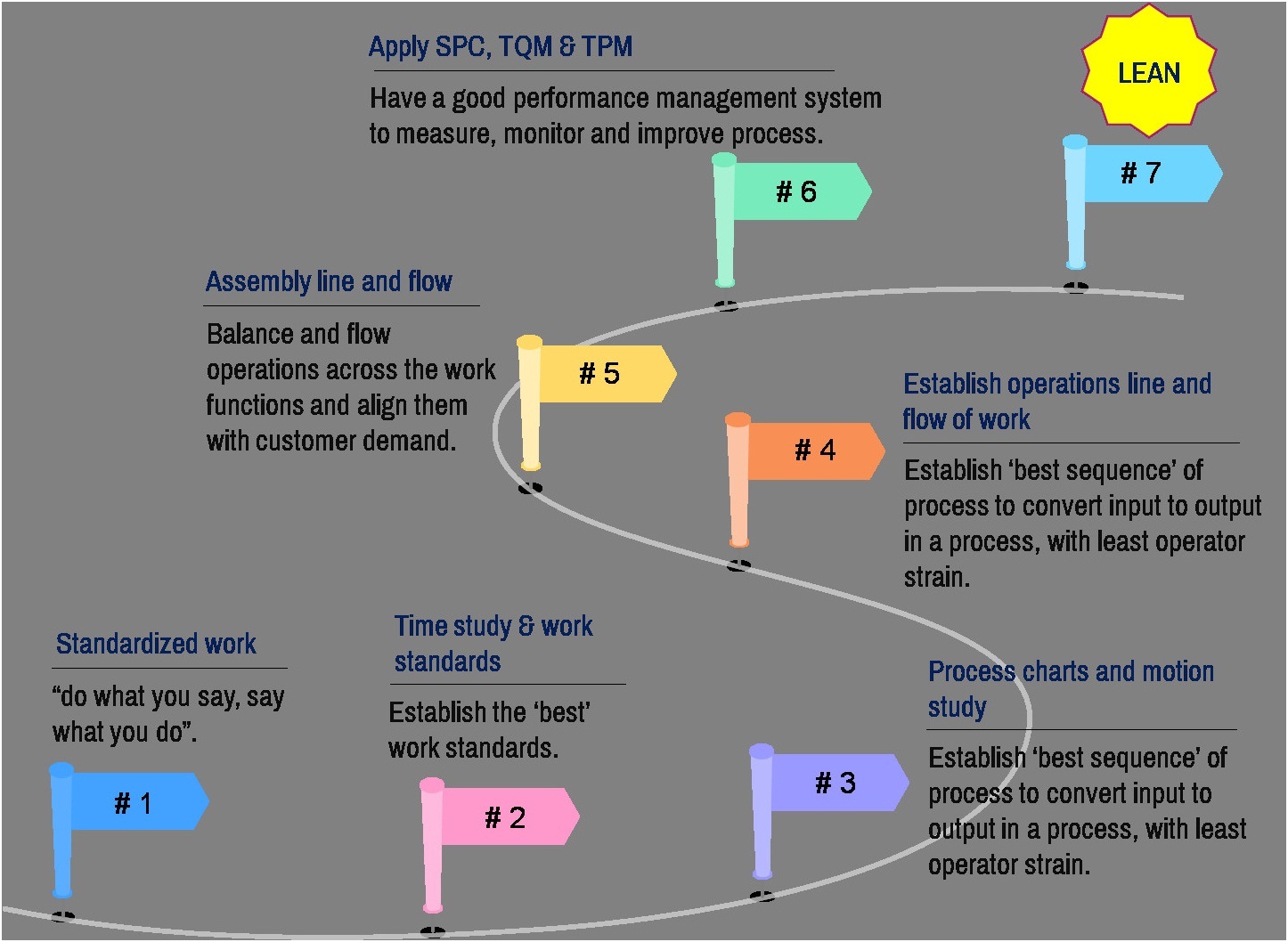
Below is the list of several foundation practices which devised much before Lean did.  I have mentioned them around time they devised.  What were these practices, what was their purpose? Let us explore.  These practices came into existence in the same order as mentioned below.
  1. Standardized work: “Say (document) what you do, and do what you say (document). This is the purpose of ISO as we know.
  2. Time study and work standards: The systematic investigation and analysis of the motions and the time needed to perform a specific task to seek more efficient methods of production as well as setting time
  3. Process charts and motion study: The flow process chart is a graphic and symbolic representation of the processing activities performed on the work piece, while motion study involves various motions (ergonomic) involved.
  4. Assembly line and flow concept: How to sequence the workload in alignment with customer demand and ensure balance and flow of workload across work roles.
  5. SPC and TQM: SPC is applied to oversee and control a process. Checking and controlling the process ensures that it performs at its full potential. TQM (Total Quality Management) is a structured approach to improve the quality of products and services through constant refinements.
  6. TPM (Total Productive Maintenance) : In industry, total productive maintenance (TPM) is a system of preserving and improving the integrity of production and quality systems through the machines, equipment, processes, and employees that add business value to an organization.
  7. Just in time or World class or Lean manufacturing: “Produce to demand” by the customer, who is the next process. World class manufacturing is synonymous with Lean manufacturing today.  It is a collection of concepts, which set standard for production for another organization to follow. Japanese manufacturing is credited with pioneer in concept of world-class manufacturing.  Some of the techniques are as follows:
  • Make to order
  • Streamlined Flow
  • Smaller lot sizes
  • Collection of parts
  • Doing it right first time
  • Cellular or group manufacturing
  • Total preventive maintenance
  • Quick replacement
  • Zero Defects
  • Just in Time
  • Increased consistency
  • Higher employee involvement
  • Cross Functional Teams
  • Multi-Skilled employees
  • Visual Signalling
  • Statistical process control
It took more than 100 years to reach here! Each discovery laid a foundation for the next one.  Each discovery after some time led to a renewed need, and therefore a need for new discovery, one after another. 

Lean Implementation

Today companies aim at # 7, without due considerations given to # 1 to 6.  Companies lack the foundation practice which is # 1 to 6. 

“Where is the money?” Is a good question to ask, but “Where is the foundation?” Is a better question to ask first?  Constant firefighting points out absence of foundation practices. 

What happens when we try to jump to step # 7 directly in a ladder? We may fall!  So companies skip steps # 1 to 6, jump to 7 directly and experience a fall.  It is time, we learn from evolution of Lean philosophy. 

PS: You may find this e-book useful too : Lean principles simplified

Visit SKIL to know more about Six Sigma Certification, Lean Six Sigma Black Belt, Lean Certification, Project Management, Lean Six Sigma Green Belt, etc.